
Megawatt Roads
The third act of one story: the same pads that charge parked electric vehicles today become energized highway corridors.
Dock charging is the product you can buy today. This page is where the network goes. The same OSPREY panel that charges a parked truck at a dock works at highway speed, so every static deployment is a node in a corridor that has not been energized yet.
How the network actually gets built.
Each step is commercially standalone. None of them depend on the next one existing.
Static dock charging
OSPREY pads flush in the apron at dock doors, staging lanes, depots, and yards. Trucks charge automatically for the entire dwell. Revenue product today.
Yard and drayage pilots
Multiple pads across a yard or port terminal. Short repeated stops keep drayage tractors topped up all shift on the site power that is already there.
Corridor pilots
The first energized segments on real freight routes: booster nodes on 0.5 to 1 MW grid connections, roughly every ten miles, embedded in existing pavement.
The future of charging may not look like charging at all.
It may look like a truck rolling down the interstate, pulling energy from the road beneath it, never needing to stop just to refuel. That sounds futuristic, but the physics are already pointing in that direction. Electric freight already works. The question now is not whether battery-electric trucks can move freight. It is whether we scale them with bigger parking lots and bigger chargers, or with a smarter infrastructure model entirely. The better answer is megawatt roads.
The Run on Less "Messy Middle" demonstration helps show why. Across four battery-electric trucks in this analysis, spanning different manufacturers, duty cycles, and load profiles, energy consumption fell within a narrow band of 1.82 to 2.11 kWh per mile. That consistency is more important than it may first appear. It means freight energy demand is not random. It is predictable enough to design around. And that opens the door to a much more exciting idea than simply charging trucks faster once they stop.
What the Run on Less data tells us
At typical highway speeds of around 55 mph, that level of efficiency translates into a moving power demand of roughly 100 to 120 kW. The physics of freight electrification are surprisingly stable. Trucks consume energy in a way that is strongly correlated with speed, weight, and distance traveled. The Windrose W9, operated by JoyRide Logistics as part of the same demonstration, reinforces this from a different angle. The Windrose averaged 1.82 kWh per mile at an average loaded weight of 33 tons, the heaviest duty cycle across all four trucks in this analysis. That efficiency, achieved under real freight conditions with a full load, further tightens the confidence interval around the 2 kWh per mile figure. Freight energy demand is not just consistent across duty cycles. It holds up under load.
It is worth being precise about what Run on Less was designed to show. The participating trucks operated in the Messy Middle, across duty cycles ranging from short regional work to several multi-hundred-mile operating days. That is what makes the dataset valuable: it reflects real-world variability where infrastructure constraints matter more than idealized vehicle specs. But it should not be mistaken for proof that the same charging model can scale to fully electrify 500-mile long-haul corridors. That is a different infrastructure problem altogether. What the results do show is the shape of the challenge. If friction already appears in the middle mile, it becomes far more consequential when freight is pushed into higher-mileage, tighter-utilization long-haul service. The results paint a credible picture of exactly where the current model starts to fail.
Why megawatt charging is emerging
Long-haul freight routes commonly span 300 to 500 miles in a day. At roughly 2 kWh per mile, that means trucks require somewhere between 600 and 1,000 kWh of energy to complete those routes. This is precisely why Megawatt Charging System infrastructure is now emerging. MCS is designed to deliver 1 MW or more of power per vehicle, enabling trucks to recover large amounts of energy during short periods. For early deployments and small fleets, this model works well. A limited number of megawatt chargers installed at a depot or truck stop can support the first wave of electric freight vehicles. Trucks arrive, recharge quickly, and return to service much like diesel refueling today.
But the economics of that model begin to strain as fleets scale.
The infrastructure scaling problem
Consider a freight hub supporting 200 electric trucks per day. If each truck requires roughly 700 kWh of energy, the site must deliver around 140 MWh of electricity every day, roughly equivalent to a day of electricity for nearly 5,000 US homes. The real constraint is not the energy itself but the power required to deliver it quickly. If trucks charge during 30-minute rest periods, multiple vehicles must charge simultaneously. Even with relatively smooth dispatch patterns, the facility could easily require 10 to 20 MW of peak electrical capacity.
In real freight operations, arrivals often cluster around dispatch schedules and shift changes, pushing peak demand even higher. Facilities supporting 100 to 200 trucks per day, with clustered arrivals and megawatt-class chargers delivering 400 kW to 1.2 MW per vehicle, can face 10 to 30 MW peak loads. In many regions, utilities limit new distribution interconnections to 2 to 5 MW without major upgrades, meaning scaling these hubs nationwide could require billions of dollars and years of grid expansion.
More than $30 billion in investment has already been committed to medium and heavy-duty charging infrastructure, and that covers only the earliest phase of a national buildout. The full cost, when accounting for grid upgrades, land acquisition, substation construction, and stranded investment risk at each individual site, is considerably larger than the charger equipment alone.
The infrastructure behind the charger is the real constraint to full freight electrification.
One of the clearest lessons from the Run on Less data is that the challenge is not only how much energy electric trucks consume, but what it actually takes to deliver that energy reliably at scale. In the current model, energy recovery is still a separate operational event. Trucks move freight, stop to charge, then resume. The charger is visible. The infrastructure behind it is not. And that is where the model breaks down.
The Windrose and the Tesla Semi in the demonstration performed well precisely because they had access to real infrastructure. The Windrose reached 738 kW peak charge rates. The Tesla Semis operated at Greenlane and PepsiCo sites with megawatt-class capability. These trucks showed what is possible when the charging network shows up.
But it only holds as long as the infrastructure does. And the infrastructure is the hard part.
A single high-performance charging site requires land, utility interconnection, substation capacity, and years of permitting before a single truck plugs in. And once it exists, the Windrose's experience shows what operations look like at their best: around 2 hours of stationary charging per operating day, time when the driver is on shift, the truck is not moving, and no freight is being delivered. Scale that across thousands of sites, clustered arrivals, and 30 MW peak loads at major hubs, and the grid math stops working long before the trucks do.
Dynamic wireless charging is not a replacement for that infrastructure. It is the complementary layer that takes the pressure off it. Energy delivered continuously along the route means trucks arrive at hubs with fuller batteries, peak loads shrink, and the sites that do get built serve more trucks with less grid capacity. The charging network and the charging road work together. One handles the stops. The other handles the miles in between.
Rethinking how energy is delivered
The Run on Less data offers another perspective. If trucks consume roughly 2 kWh per mile, that number can be compared directly with the energy that could be delivered while the vehicle is moving. A roadway segment capable of delivering 500 kW of wireless power would provide roughly 9 kWh of energy for every mile the truck travels across it at 55 mph. That is more than four times the energy the truck consumes over the same distance.
Electric vehicles are already being engineered to accept megawatt-scale charging. That means a truck could carry two wireless receivers onboard, each delivering roughly 500 kW. In effect, the truck could receive 1 MW of charging power while driving. At that point, the required energized coverage drops to roughly 10 to 11 percent of the corridor. In practical terms, this could look like one mile of energized roadway followed by eight or nine miles of normal pavement, repeated along the route. Trucks gradually receive energy while traveling and never need to stop.
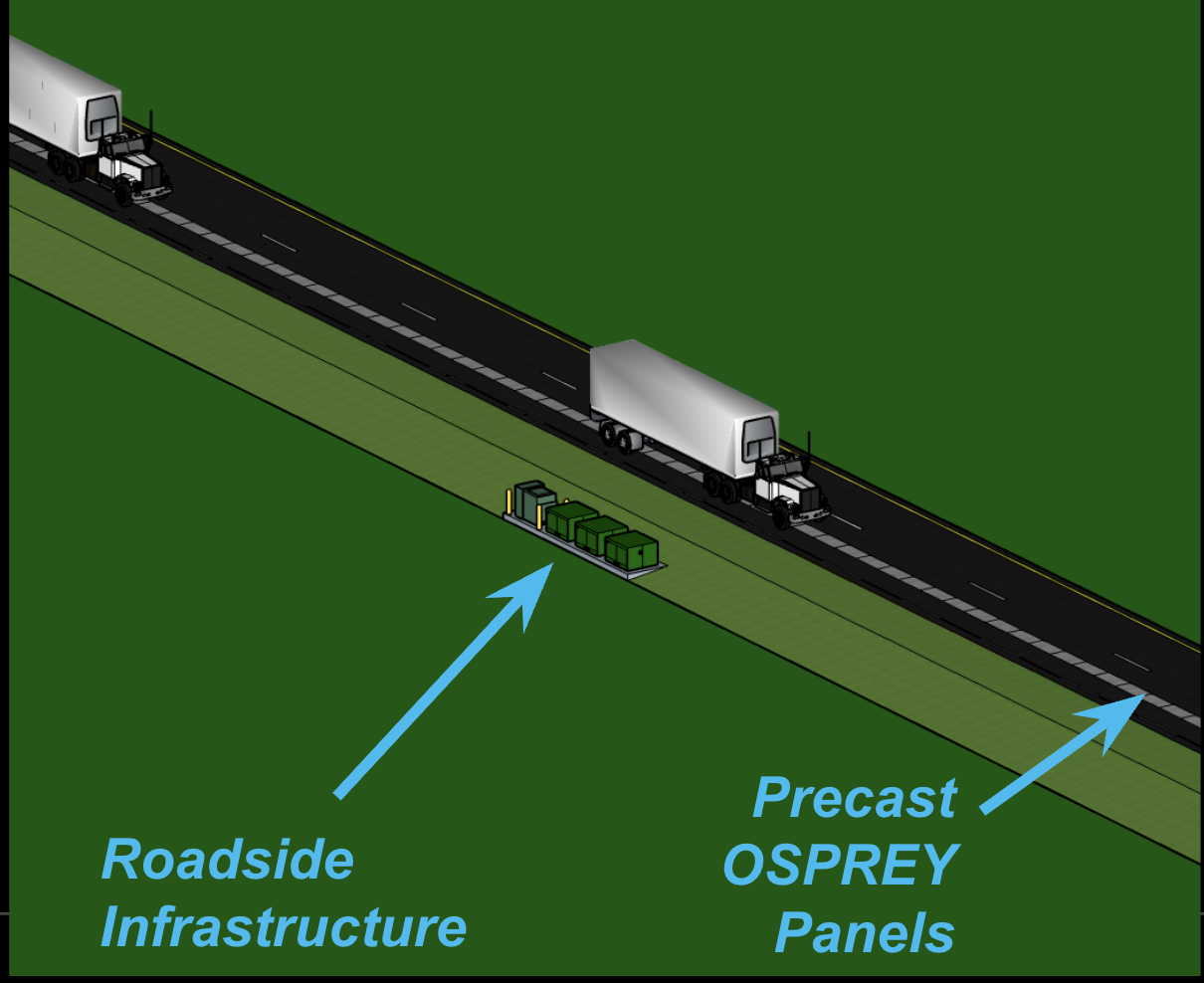
The technology to make this real already exists. Electrovia has demonstrated 505 kW of wireless power transfer via a panel designed to be embedded directly in the roadway, more than doubling the previous record. At that power level, the roughly 10 percent corridor coverage math works today. The infrastructure question is no longer whether wireless road charging is technically feasible. It is whether we build it.
There is also an infrastructure assumption buried in the centralized charging model that rarely gets examined: it requires new construction. DC fast charging hubs need land, grading, pavement, electrical vaults, and utility easements before a single truck charges. In many freight corridors that means acquiring property in industrial areas where land is neither cheap nor readily available, then waiting years for utility interconnection approvals. Electrovia's in-motion high-power wireless approach inverts that assumption entirely. The panels are designed to be embedded in existing roadway pavement. The infrastructure is already there, already maintained, and already connected to the freight network by definition. The highway becomes the charging station, and we believe the legislation exists today to enable the highway becoming the charging station. There is no new footprint, no new land acquisition, and no competing with warehouses and distribution centers for the same industrial parcels. The 47,000 miles of Interstate Highway already crossing the country are not a constraint to work around. They are the infrastructure.
Instead of concentrating tens of megawatts of demand at a single truck stop, energy can be supplied through a chain of smaller nodes, what we call booster stations, located along the corridor, each requiring only 0.5 to 1 MW of grid connection and spaced roughly every 10 miles. In rural areas where land is inexpensive and abundant, these booster stations can incorporate solar generation and battery storage, allowing energy to be produced and buffered locally. Batteries provide bursts of power when trucks pass over charging segments, enabling the grid connection itself to remain modest while still supporting megawatt-scale wireless charging events. These distributed sites create new economic opportunities for utilities along the route and, over time, could serve as natural entry points for next-generation energy technologies.
Why the cost comparison favors megawatt roads at scale
The case for megawatt roads is not just technical. It is also financial. And it rests on three distinct cost advantages that conventional infrastructure comparisons consistently fail to account for together.
The first is in the vehicle itself.
Today's long-range electric truck is carrying a large amount of battery not because that is the ideal vehicle design, but because the road provides no energy. In effect, the truck is forced to haul part of its fueling infrastructure around with it all day. That is an expensive workaround. At current battery pack benchmarks of roughly $130 to $160 per kWh, a long-haul truck battery can represent tens of thousands of dollars of cost on its own. Tesla's published Semi specs imply a pack on the order of 850 kWh to support a 500-mile route, while Windrose publicly lists a 729 kWh battery. That means a meaningful share of the vehicle's upfront capital is tied up in battery capacity that exists largely to bridge gaps in infrastructure rather than to optimize the truck itself. If dynamic road charging allows fleets to remove even 300 to 350 kWh from the battery, the savings are on the order of $40,000 to $55,000 per truck at full pack cost benchmarks. Across a fleet of 500 trucks that is $20 to $28 million in capital savings on the vehicle side alone, before a single road panel is installed. At 1,000 trucks it reaches $55 million. And that is before accounting for the second-order benefits: less weight, and less replacement exposure over time. Dynamic charging changes the design logic. Instead of asking every truck to carry the full burden of range onboard, the roadway can begin sharing that burden. That is what makes megawatt roads more than a charging concept. It is a different economic architecture for freight.
The second saving is in the infrastructure.
The honest comparison is not a wireless road mile versus nothing. It is the full system cost of serving a corridor that centralized charging cannot yet serve at all: 500 miles, where today's best long-haul electric trucks are operating at or near the edge of their range envelope under real freight conditions, with little margin for elevation, temperature, and payload variation. On a 500-mile corridor serving 1,000 trucks per day, the centralized model requires every truck to stop twice: once mid-route for roughly 25 minutes to safely complete the corridor, and again at the destination for 35 minutes or more to recharge for the return leg. That is 60 minutes of charging time per one-way trip, even with MCS infrastructure at every stop, and 1,000 truck-hours of downtime every day. The infrastructure to support those stops, a full-charge depot at the origin, a mid-route hub, and a recovery facility at the destination, runs approximately $292 million across three sites, three substations, and three utility interconnection queues measured in years not months. Fifty distributed corridor nodes paired with two small top-up depots cost approximately $260 million, require no substations, no new land, and eliminate the mid-route stop entirely. The truck arrives at its destination at 89% charge, needs only a 16-minute top-up before the return leg. The fleet recovers $41 million per year in productivity the centralized model cannot get back. Amazon's delivery network looks absurd at the scale of a few packages. At 40 percent of US e-commerce it puts goods on your doorstep in hours. The same logic applies here. A single energized corridor is a proof of concept. The same infrastructure threaded across the corridors carrying the majority of US freight ton-miles becomes the backbone of a fully electric long-haul network.
The third saving is in what happens at the other end of the route.
In the centralized model, a truck stop is a point of peak grid stress. Trucks arrive depleted, plug in simultaneously, and the facility draws enormous power pulses from the grid to fill them. In a megawatt roads model, trucks arrive having collected energy along the route. They do not arrive needing the grid. They arrive offering it something. A truck stop serving 200 fully charged Class 8 trucks overnight holds roughly 115 MWh of accessible battery capacity, the equivalent of 29 one-megawatt peaker plants running for four hours, or enough to power nearly 4,000 homes for a full day. At 500 trucks the buffer reaches 288 MWh. That capacity can support local grid stability, provide backup power, and generate revenue for operators in wholesale energy markets. The charging hub does not disappear in this model. It inverts. Instead of being one of the grid's largest point loads, it becomes one of its most valuable buffers. That is not a secondary benefit. It is a structural transformation in the relationship between freight infrastructure and the electrical grid.
A new way to think about electric transportation
Megawatt charging will almost certainly play a role in the electrification of freight. But the Run on Less data points toward a complementary path, and an honest cost accounting points toward the same conclusion. The demonstration answered the question it was designed to answer: electric freight works in the messy middle. That is an important result. But the messy middle is not the whole problem. The 500-mile long-haul corridor, the backbone of American freight, was not represented in this dataset because no centralized charging architecture yet exists that could support it at scale. Dynamic wireless charging is not a refinement of the centralized model. It is the missing architecture that makes the extrapolation from regional to long-haul possible.
Because vehicle energy demand is predictable, energy does not have to be delivered all at once at a single location. It can be delivered gradually, along the route itself. A truck consuming 2 kWh per mile at highway speed is drawing power continuously, steadily, and predictably. That predictability is the design input the centralized model ignores and the dynamic model is built around. Highways do not have to be passive surfaces that trucks cross on the way to a charger. They can be the charger.
Electrovia's technology makes that a real option today. Wireless charging panels embedded in existing pavement, booster stations connecting at standard distribution grid voltages, no new substations, no land acquisition, no utility queues. And critically, the infrastructure serves every electric vehicle that passes over it, not just freight trucks. Passenger EVs, delivery vans, buses, and Class 8 semis all draw from the same corridor.
That is the thesis. Unlimited electric transport does not require a charger at every destination or a battery large enough to reach it. It requires roads that participate in the energy system. Roads that are already there, already maintained, already connecting every origin to every destination in the country. The centralized model asks vehicles to come to the energy. The megawatt road brings the energy to the vehicles. We believe that shift, applied at corridor scale, offers a viable path to electrifying transportation broadly, not just the easy miles, but all of them.
The network starts at the dock.
Static deployments today. Electrified corridors tomorrow.
See static charging